
Why Token Pricing Wins for OCR (And Your Wallet Will Thank You)
Two developers each processed 10,000 images last month. Developer Alex paid $500. Developer Sam paid $37. They processed the exact same images. The only difference? Alex used a per-page OCR provider. Sam used token-based pricing from ocrskill.com.
That is not a typo. That is the real price gap between old-school per-image billing and modern token-based OCR pricing. And if you are still paying per page for text extraction rather than using a dedicated OCR skill, you are probably subsidizing someone else’s massive document processing with your simple screenshots.
The Per-Page Pricing Trap
Traditional OCR providers love per-page billing. You know the model: $0.01 to $0.05 per image, regardless of what is actually in that image. It sounds simple. It sounds predictable. But it hides a massive unfairness that you have probably never questioned.
Here is what per-page pricing actually means in practice:
- Your one-line screenshot of a notification costs the same as someone’s 50-page legal contract
- Your tiny UI element image costs the same as a full A4 scan packed with 2,000 words
- You pay for whitespace, margins, and empty areas that contain zero text
- Low-text images subsidize high-text images across the entire customer base
The model made sense twenty years ago when OCR was basic pattern matching and compute costs were harder to track. But modern AI-powered OCR does not process “pages.” It processes tokens. And that distinction matters because it opens up a fundamentally fairer way to charge for text extraction.
What Token Pricing Actually Means
Instead of charging per image, a modern Claude code OCR skill like ocrskill.com charges per token. A token is roughly a piece of a word, about 4 characters on average. The pricing is straightforward:
- $1.30 per million prompt tokens (the image you send)
- $1.50 per million completion tokens (the text we extract and return)
That is it. No per-page minimums. No tiered pricing brackets. No hidden fees for “document complexity.” You pay for exactly what gets processed and exactly what gets produced.
Think about it this way: when you send us a screenshot, we are not pushing paper through a scanner. We are running an AI model that analyzes pixels and generates text. The computational work scales with the amount of text in your image and the amount of text that comes out. A mostly empty image takes less work than a dense document. Token pricing reflects that reality. Per-page pricing ignores it entirely.
Real Numbers: Let’s Compare Actual Costs
Theory is nice, but numbers are better. Here are two real examples using actual images processed through ocrskill.com.
Example 1: A Simple Screenshot
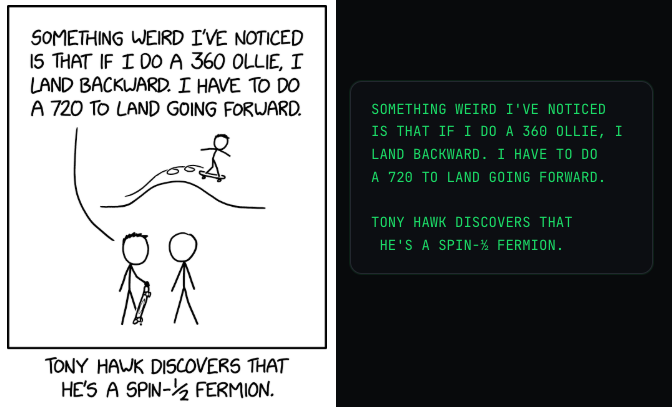
Take a typical xkcd comic screenshot at 336x407 pixels. It has a caption, some speech bubbles, and a title.
- Prompt tokens: 211 (the image input)
- Completion tokens: 67 (the extracted text)
- Total tokens: 278
- Your cost: $0.00037
That is less than four hundredths of a cent. With per-page pricing at even the cheapest rate of $0.01 per image, you would pay 27 times more. At a more typical $0.05 per page, you would pay 135 times more.
Example 2: A Full A4 Document
Now consider a scanned A4 page at 822x1141 pixels, completely filled with text. This is a dense document with paragraphs, headers, and formatting.
- Prompt tokens: 1261 (the image input)
- Completion tokens: 1288 (the extracted text)
- Total tokens: 2549
- Your cost: $0.00357
Even for this full page of dense text, your cost is about one third of a cent. Compare that to per-page pricing: at $0.01 you pay 3x more. At $0.05 you pay 14x more.

The 10,000 Image Scenario
Remember Alex and Sam from the opening? Here is how their bills broke down. Both developers processed a mix of screenshots, mobile app captures, scanned receipts, and full documents. The distribution looked roughly like this:
| Image Type | Quantity | Per-Page Cost | Token Cost |
|---|---|---|---|
| Small screenshots | 4,000 | $0.02 avg | $0.00037 |
| Medium captures | 4,000 | $0.02 avg | $0.00120 |
| Full documents | 2,000 | $0.02 avg | $0.00357 |
| Total (10,000) | $200-$500 | $37 |
That $463 difference is not magic. It is simply the gap between flat-rate pricing that ignores actual usage and metered pricing that reflects it.
Why Token Pricing Is Actually Fairer
Fairness in pricing is about alignment. When the price you pay aligns with the value you receive and the cost to deliver it, everyone wins. Token pricing creates that alignment in three specific ways.
First, small images are not penalized. If you are building a UI automation tool that screenshots buttons and labels, you should not pay the same rate as someone extracting text from a 50-page PDF. Your tiny images take less compute, less memory, and less time. Token pricing charges you proportionally less. Per-page pricing does not care.
Second, high-text documents pay their fair share. Someone extracting a 10,000 word technical manual generates more tokens than someone extracting a receipt. Under token pricing, they pay more. That is fair. They are using more of the service. But under per-page pricing, both might pay the same flat rate, which means low-text users subsidize high-text users.
Third, you stop paying for nothing. Empty margins in a scanned document. Whitespace around a screenshot. Background noise in a photo. None of that generates tokens. None of that adds to your bill. Per-page pricing charges you for the entire image area regardless of content density.
“But Per-Page Pricing Is Predictable!”
This is the most common objection we hear. Developers and finance teams love predictable line items. “We know we will process 10,000 pages, so we know it will cost $200.” That predictability feels safe.
But that safety is expensive. You are paying a massive premium for the comfort of a round number. And here is the thing: token usage is actually very predictable once you run a small sample. Most workflows have consistent patterns. Your screenshots are roughly the same size. Your documents fall into predictable categories. After processing even 100 images, you will have a clear sense of your average tokens per image and can project costs accurately.
The difference is that with token pricing, your projections reflect reality. With per-page pricing, your “predictability” is just a fixed overpayment that never adjusts down when you process simpler images.
Plus, the ocrskill.com dashboard gives you full visibility into your token usage. Check it daily for the first week, note your average tokens per image, and you will have projections more accurate than any per-page estimate.
Token Pricing in Practice
Switching to a token-based Claude skill OCR workflow is straightforward. The ocrskill.com dashboard gives you complete visibility into your spending, showing daily token usage and accumulated costs at a glance. You can see patterns over time, identify which workflows consume the most tokens, and adjust your approach accordingly.
For teams that need programmatic tracking, you can estimate costs upfront by sampling your typical images. Run a small batch through the API, note the response times and output sizes as rough proxies for token count, and extrapolate from there. Most customers find that after a brief adjustment period, token-based budgeting becomes second nature. And the savings speak for themselves.
Claude OCR Skill
Check out our claude-skill if you want to save money when processing large numbers of documents. Simply drop the ocrskill-ocr/ directory into ~/.claude/skills/ (for personal use) or .claude/skills/ (for project-level access), and Claude will discover it automatically.
Frequently Asked Questions
How do I estimate my token costs before switching?
Run a representative sample of 50 to 100 images through the API and average the token counts. Most workflows have consistent patterns: mobile screenshots are typically 200-500 tokens, desktop captures run 500-1500 tokens, and full document pages range from 1000-5000 tokens depending on text density. Multiply your average by your monthly volume and the per-million token price to get your projected cost.
What if I process huge multi-page documents?
Large documents generate more tokens, which means they cost more. That is the point. But even a 10-page document with dense text typically costs under $0.05 with token pricing, while per-page providers would charge $0.10 to $0.50 for the same document. You still save money, and the pricing reflects the actual work performed.
Is there a minimum charge per request?
No. If you send us a 100x100 pixel icon with 5 characters of text, you might use 50 tokens total. That costs $0.000065. We do not round up. We do not have minimums. You pay for exactly what you use.
How does this compare to AWS Textract or Google Document AI?
AWS Textract charges per page with tiered pricing that starts at $0.0015 for basic text but jumps to $0.015 or higher for forms and tables. Google Document AI similarly charges per page with complex pricing tiers. Both require you to estimate which “type” of processing applies. Token pricing is simpler: you send an image, we extract text, you pay for the tokens used. No tiers, no page classifications, no surprise overages when your “form” turns out to be a “table.”
How does this compare to using Claude Vision directly?
If you are building a Claude OCR skill, you might wonder why not just send images directly to Anthropic’s Claude Vision API. The answer comes down to pure economics. Direct Claude vision pricing is typically 15 to 20 times more expensive per image than ocrskill.com’s optimized token pricing. By using our dedicated API as your OCR engine, you get enterprise-grade text extraction without the massive markup on visual tokens.
Can I set spending limits or get alerts?
Yes. The ocrskill.com dashboard shows your daily token usage and accumulated spend at a glance. For proactive alerts, estimate your average tokens per image after a small sample batch, then track image counts in your application and multiply by your average to trigger alerts at 80% of budget. For hard limits, you can also stop sending requests based on daily image counts once you reach your threshold.
Why do prompt tokens cost less than completion tokens?
Prompt tokens represent the input image analysis, while completion tokens represent the generated text output. Generating coherent, structured text requires more computational work than analyzing input pixels, so completion tokens carry a slightly higher rate. This pricing model aligns with how modern AI APIs work across the industry.
Conclusion: Pay for What You Use, Not What You Hope to Avoid
The per-page pricing model is a relic. It comes from an era when OCR was simpler and computing costs were harder to meter. Today, AI-powered text extraction processes tokens, not pages. And when you align your pricing with that reality, the savings are dramatic.
Whether you are processing thousands of screenshots for automation, extracting data from scanned receipts, or building document pipelines, integrating advanced OCR skills with token-based pricing from ocrskill.com puts you back in control. You pay for the actual work done. You stop subsidizing other customers with your simple images. And you get transparency into exactly what each extraction costs.
Stop paying for empty margins. Stop paying the same rate for one-line notifications as for 50-page contracts. The math is clear, the savings are real, and your wallet will thank you.
Ready to see the difference? Get your free API key and process your first images in under a minute. Monitor your usage on the ocrskill.com dashboard and do the math yourself. The numbers do not lie.