The Blog
Tutorials, teardowns, and agentic AI workflows for the creator economy.

Non-Itemized Receipt: What It Is, Why Claims Get Rejected, and How to Catch One
A non-itemized receipt shows a total but not what was bought. Learn why expense policies and IRS rules often need the itemized version, what to do when the card slip is all you have, and how to flag non-itemized receipts automatically with OCR and a short Python check.
Read more →
Air Waybill OCR: Read MAWBs and HAWBs into Checked Shipment Data
Air waybill OCR for forwarders and import desks: when the e-AWB message makes OCR unnecessary, which AWB boxes to extract, how to read house and master air waybills into Markdown, and a Python checker for AWB check digits, chargeable weight, and rate line totals.
Read more →
OCR for Customs Declarations: Read Entry Summaries into Audit-Ready Data
OCR for customs declarations, explained for importers and brokers: when to pull ACE data instead, which CBP Form 7501 blocks to extract, what OCR output of an entry summary looks like, and a Python checker for check digits, HTS format, and duty totals.
Read more →
Why Is OCR So Bad? Diagnose Bad Output Before You Switch Tools
Why is OCR so bad on your documents? Most failures come from tiny or compressed text, skewed photos, multi-column layouts, handwriting, codes, or a stale PDF text layer. Use these checks and a short Python triage script to find the cause and fix it.
Read more →
PaddleOCR vs Claude Vision: Which Should Read Your Documents?
PaddleOCR vs Claude vision for document OCR: compare outputs, confidence scores and boxes, self-hosting versus per-token cost, benchmark coverage, and failure modes, then run both on your own pages with a short Python script before you choose.
Read more →
OCR Incoming Inspection: Read IQC Check Sheets, CoAs, and Receiving Reports
Searched for OCR incoming inspection? Learn how to turn receiving check sheets, certificates of analysis, and material certs into searchable Markdown, pull supplier header fields as typed JSON, and keep lot, measurement, and disposition lines in a review path your QMS still owns.
Read more →
Verification of Employment Form Data Extractor: Turn VOE Scans into Typed JSON
Searched for a verification of employment form data extractor? Learn how to pull employee name, employer, and address fields from VOE scans and employer reply letters with schema-field OCR, keep pay and tenure details in Markdown for review, and leave employment decisions to your underwriting stack.
Read more →
OCR Model Guide: Classic Engines, Document VLMs, or General Vision Models
Choosing an OCR model in 2026? Compare classic OCR engines, small specialized document VLMs like PaddleOCR-VL, MinerU2.5, and olmOCR 2, and general vision models like Gemini and GPT, using OmniDocBench and olmOCR-Bench results. Then score candidates on your own pages with a runnable Python harness.
Read more →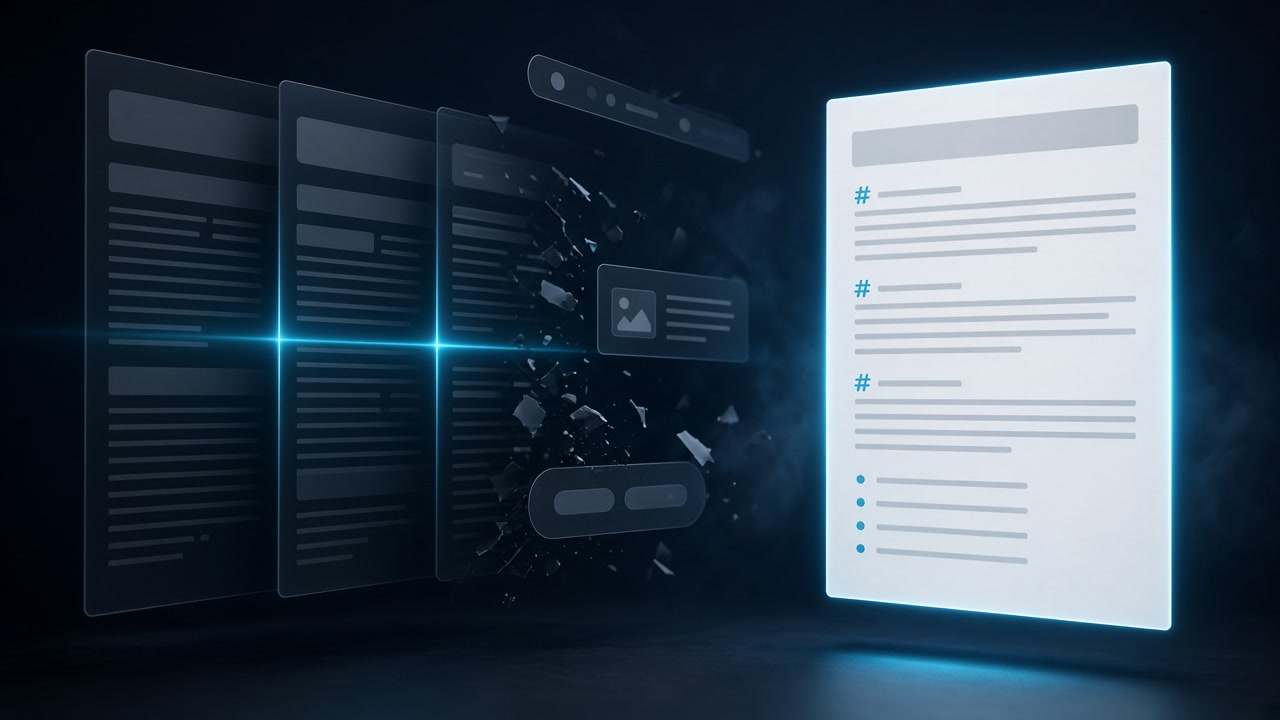
Image to Markdown OCR for Article Screenshots: Strip the Page, Stitch the Scroll
Image to Markdown OCR for article screenshots: turn a captured news story, blog post, or newsletter into clean Markdown with one headline, real headings, and a source URL, then strip nav bars, ads, and cookie banners and stitch overlapping scroll captures. Includes real API output and a runnable Python cleaner.
Read more →
Shipping Label OCR: Read Tracking Numbers, Addresses, and Parcel References
Shipping label OCR for receiving docks, returns desks, and parcel exception queues: read the printed tracking number, ship-to address, and order references as Markdown, pull address fields as typed JSON, and check the printed text against the barcode before a parcel is routed, re-labeled, or booked in. Includes a runnable Python checker.
Read more →
Export Harvest to JSON: API Time Entries vs OCR for Timesheet PDFs
Need to export Harvest to JSON? Pull time entries and time reports from Harvest API v2 for live accounts, use admin CSV/Excel when a spreadsheet is enough, and OCRskill structured extraction when the input is a timesheet screenshot, PDF report printout, or paper timesheet.
Read more →
Bill of Lading OCR: Extract Parties, Ports, and Container Numbers
Bill of lading OCR for forwarders, brokers, and ops desks: turn scanned HBLs and MBLs into searchable Markdown, pull shipper and consignee cues where the schema fits, validate ISO 6346 container numbers in code, and reconcile house versus master data before the booking or entry is updated.
Read more →